
In development
Caregiving
You're keeping track of someone else's whole life.
Their medications, their appointments, their numbers, the thing the doctor said in March. Cariven holds all of it in one place, lets the rest of the family help, and doesn't make you feel worse on the days you miss something.
The problem
Why caregiving falls apart in the details
It's rarely the big decisions that break you. It's that the cardiologist wants a list of current medications and yours is a photo of a pill organizer from six weeks ago. It's your brother calling to ask whether Mom took the evening dose, and neither of you knowing.
Everything lives somewhere different — doses in your head, appointments in your calendar, the discharge summary in a folder in the car, blood pressure readings on a pad by the kettle. None of it joins up, and you're the only join.
Then you sit down in a fifteen-minute appointment and try to summarize three weeks from memory, while the person you're there for listens to you get it slightly wrong.
What it does
How Cariven organizes someone else's care
Five places for everything, and a home screen that only shows today.
Today, and only today
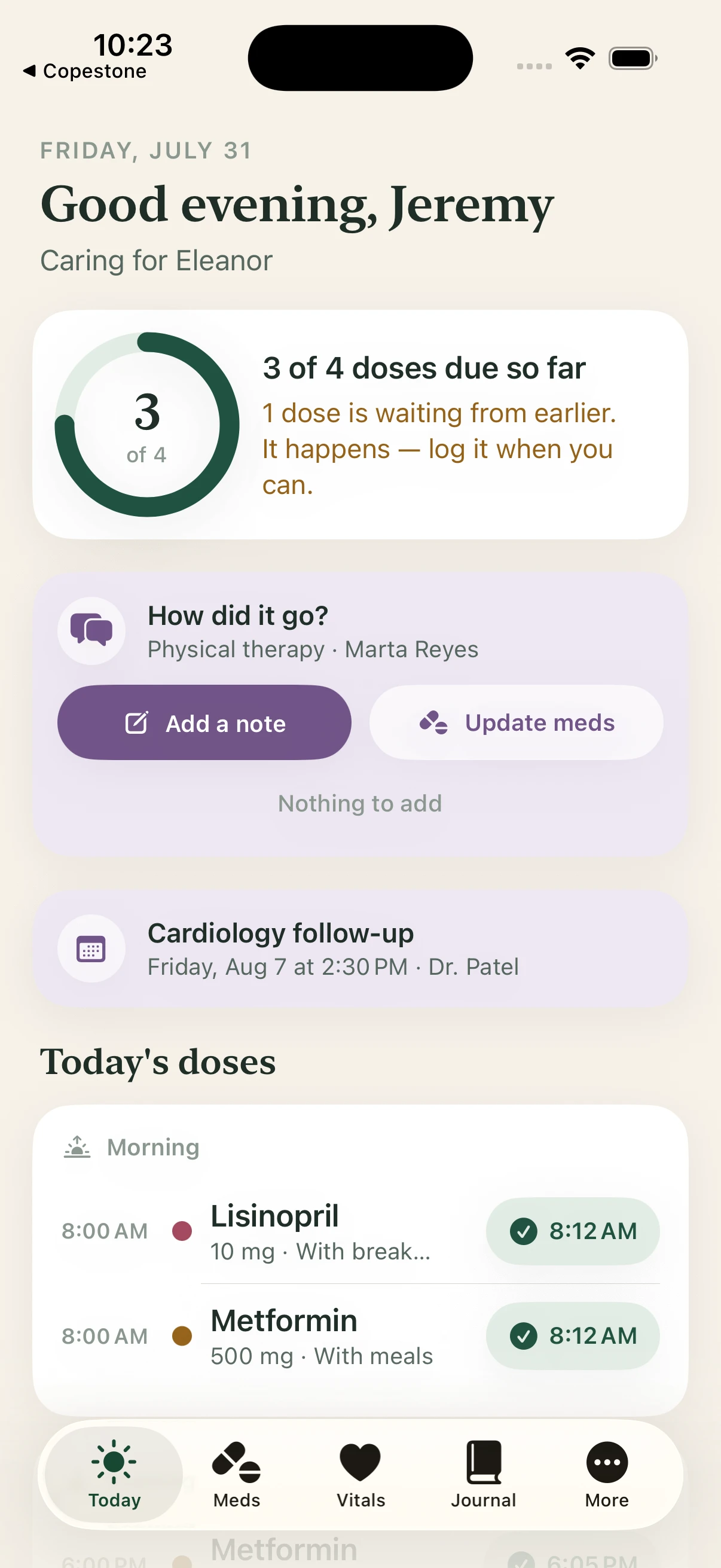
The first screen is the day: how many doses are due, what's already logged and when, the next appointment, and anything worth writing down. Three of four doses due so far. That's the whole status.
And when one's been missed, it says "1 dose is waiting from earlier. It happens — log it when you can." Which sounds like a small thing until you're doing this at ten at night and something finally isn't making you feel like you've failed.
The numbers, kept properly
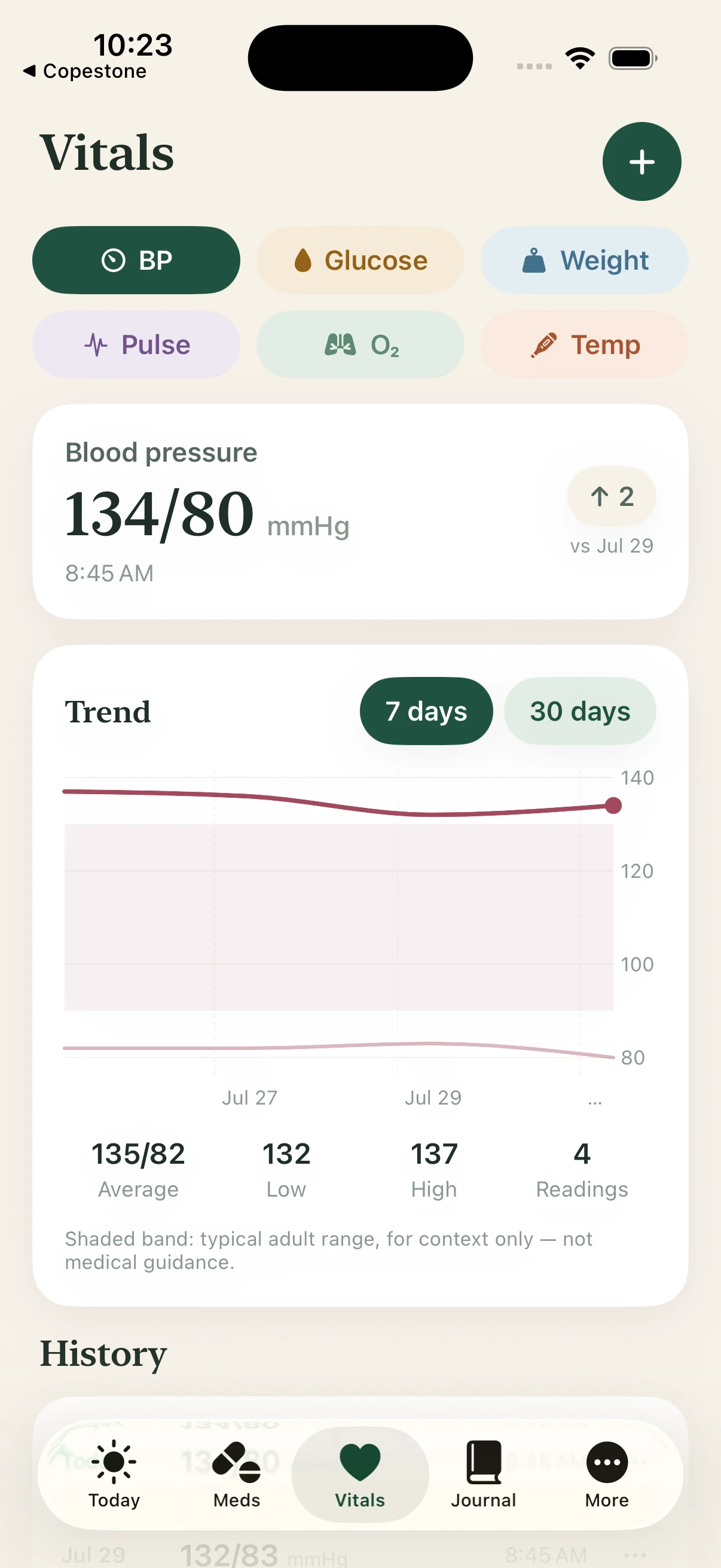
Blood pressure, glucose, weight, pulse, oxygen and temperature — logged in the app or read from Apple Health, so a reading taken on a connected cuff doesn't need typing in twice. Cariven can write back too, keeping one picture rather than two.
Everything charts over time, because "her blood pressure's been up lately" is a much better sentence when you can show what "lately" means.
Catch the appointment while you still remember it
After something's happened — a therapy session, a consultation — Cariven asks "How did it go?" and offers you two buttons: add a note, or update the medications. Those are the two things that change at an appointment, and the two things that get lost on the drive home.
Add a medication by scanning the label on the bottle rather than typing out a name you'd have to spell twice.
Physical therapy · add a note or update meds.
Sharing
Sharing the load with the rest of the family
Caregiving usually has one person doing most of it and several others who would help if they knew what was needed. A care circle fixes the knowing part: everyone sees the same medications, the same log, the same calendar.
You control what each person gets, category by category. A sibling coordinating appointments doesn't need the financial paperwork. A paid helper needs today's doses and nothing else. Roles run from full access down to view-only, and you can change or remove someone whenever you like.
The Vault holds the documents that always get asked for and are never to hand — insurance cards, the advance directive, discharge summaries — so whoever's at the hospital has them.
At the appointment
What to bring to the next doctor's appointment
Cariven turns what you've already logged into one report: the current medication list with doses and timings, recent vitals, and what's changed since last time. You hand it over instead of narrating it.
The app can also show you the official label information for a medication — what it's for, how it's usually taken, what to watch for — so you can read up before you're asked a question about it. That's reference material, deliberately: it is not an interaction checker, and it won't tell you whether two medications should be taken together. That question goes to a pharmacist or a doctor, every time.
Cariven is a record-keeping tool for people caring for someone else. It is not a medical device, it does not provide medical advice, and it must not be used to make clinical decisions. Medication label information comes from public U.S. regulatory data and may not reflect the specific product you have. Always follow the prescriber's instructions, and contact a healthcare professional with any medical question.
Pricing
Free for one person. About $5 a month for a family.
If you're caring for one person on your own, the free version is the whole app. Plus is for when more than one person is involved — on either side.
Free
- One person, fully tracked
- Medications, doses and reminders
- Vitals, with Apple Health
- Journal and appointments
- Doctor report
- Ten documents in the Vault
Plus $59.99/yr · $129.99 once
- More than one person, each fully separate
- Unlimited vault — every card, directive and summary
- Live circle sync with the people helping
Also available monthly at $9.99. The annual plan starts with a two-week free trial and works out at about $5 a month; the one-time purchase is $129.99 and never renews.
- Requires
- iOS 18.6 or later
- Devices
- iPhone and iPad
- Price
- Free · $59.99/yr or $129.99 once for Plus
- Apple Health
- Reads and writes, with your permission
- Sharing
- Per-category, revocable
- Widgets
- Lock Screen, circular and rectangular
You shouldn't have to hold all of it.
Cariven is still in development. LeasePace and STRAXE are on the App Store now, if you want to see how we finish things.