In development
Meditation & ritual
You have started a practice like this before.
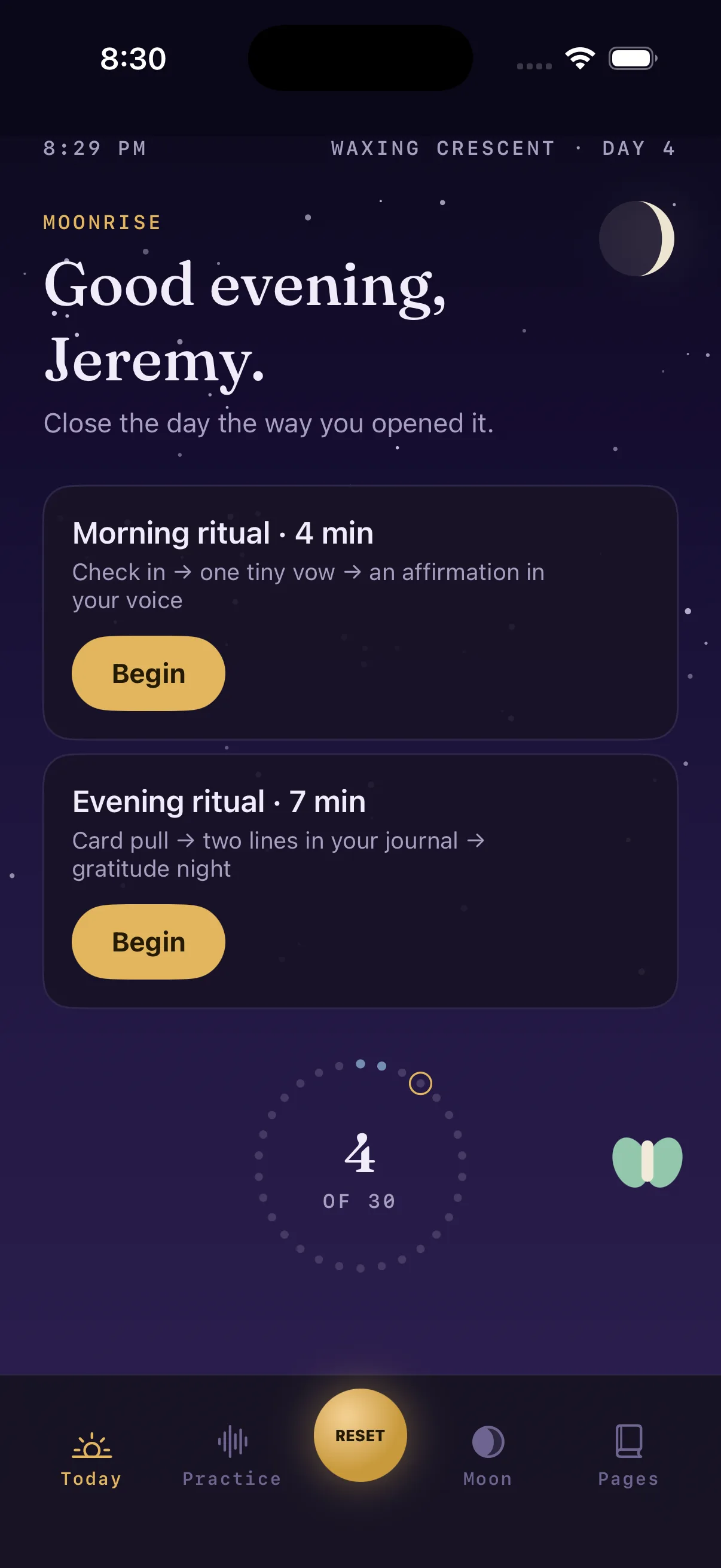
Four minutes in the morning, seven at night, and a streak drawn as a moon that never resets to zero. Voluna is built for the fourteenth day, when the novelty has worn off and you don't especially feel like it.
The problem
Why a daily practice usually stops in week two
Almost nobody quits a wellness app because it was bad. They quit because they missed a Tuesday, the counter went back to zero, and the app made a small production of it. One missed day turned into a verdict about the kind of person they are.
The rest is ambition. A twenty-minute session is a lovely idea on the evening you download it and an impossible ask on a Wednesday in February. So the streak breaks, the notification starts to feel like nagging, and the icon moves to the second home screen.
And under all of it, a quiet suspicion that you are being sold something — a subscription the same price as a gym you also don't go to, wrapped around claims that sound a little too confident about what a recording can do to your brain.
What it does
A morning ritual and an evening ritual, built around the moon
Eleven minutes a day, total. Everything else is optional.
Four minutes in the morning, seven at night
Morning is a one-minute check-in, one small vow, and an affirmation played back in your own voice. Evening is a reflection card, two lines in the journal, and a wind-down. They are called Sunrise and Moonrise, and the app opens on whichever one the hour belongs to.
The vow is deliberately tiny, and it asks for an if‑then plan underneath it — if it is 7am and I am at the kitchen table, then I write one line. Naming the moment in advance is the part that carries a plan into a real week; a 2006 meta-analysis pooling 94 studies found that pairing a goal with a specific if‑then cue meaningfully raised follow-through.
A streak drawn as a moon, that bends instead of breaking
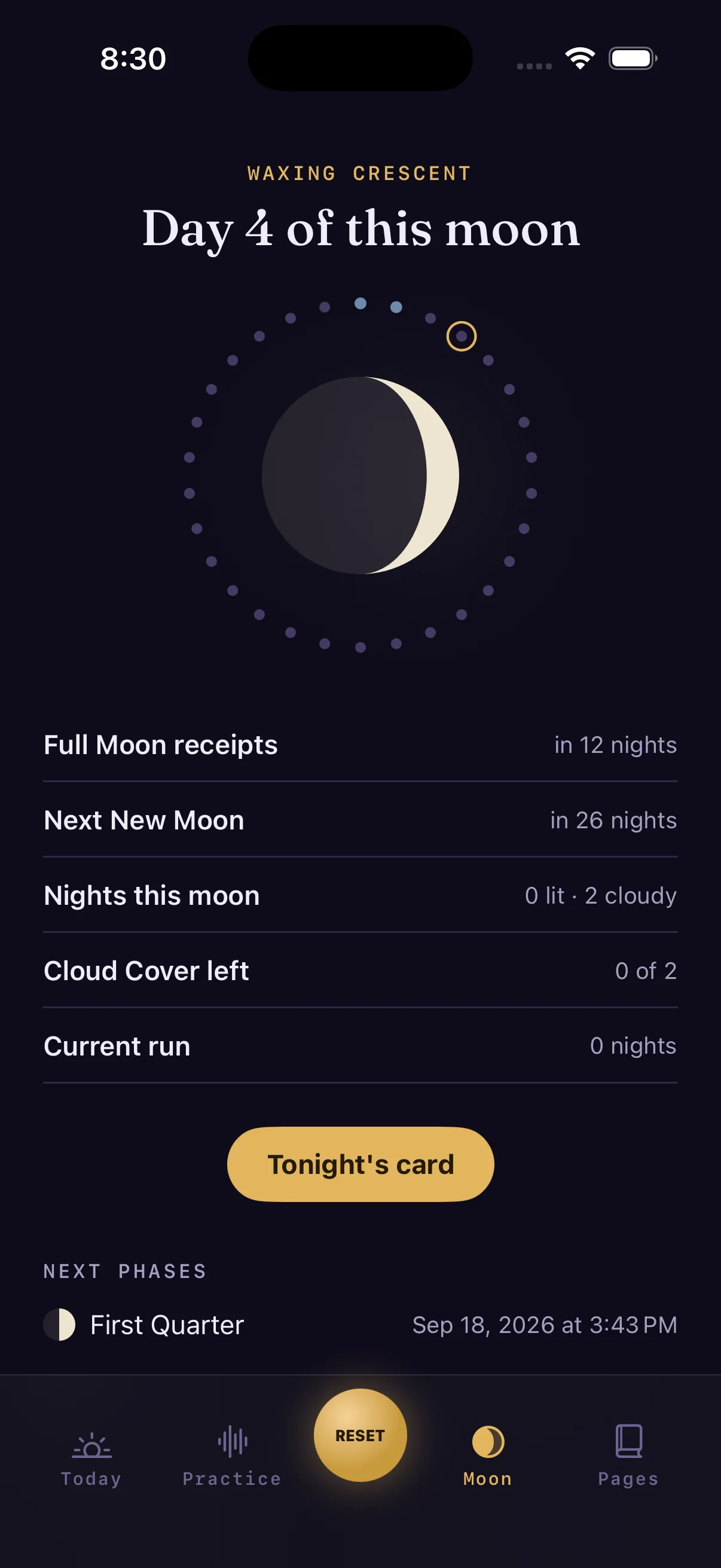
Voluna counts in lunar months rather than consecutive days. Practiced nights light a ring that fills toward Full, and the app tells you where you are — day four of this moon, Full Moon receipts in twelve nights.
Miss a night and a cloud passes over it. That is the whole penalty. There is no chain to break, no zero to fall back to, and nothing that greets your return with a guilt trip. You get a set of Cloud Cover nights each month and the ring keeps its shape either way.
Affirmations in your own voice, recorded on your iPhone
Most affirmation apps hand you a stranger reading a sentence you don't believe. Voluna is record-first: you say the line yourself, and the morning ritual plays it back to you in your own voice.
The lines are process- and values-based rather than grandiose — what you are doing and what you care about, not a declaration about who you already are. On a low-scoring check-in the app deliberately offers the gentler forms first instead of a bold I am statement.
Recording happens on the iPhone. The audio files live in your own storage and Voluna never receives them.
Check in, one tiny vow, and your own voice.
Breathwork, tones and sleep sounds
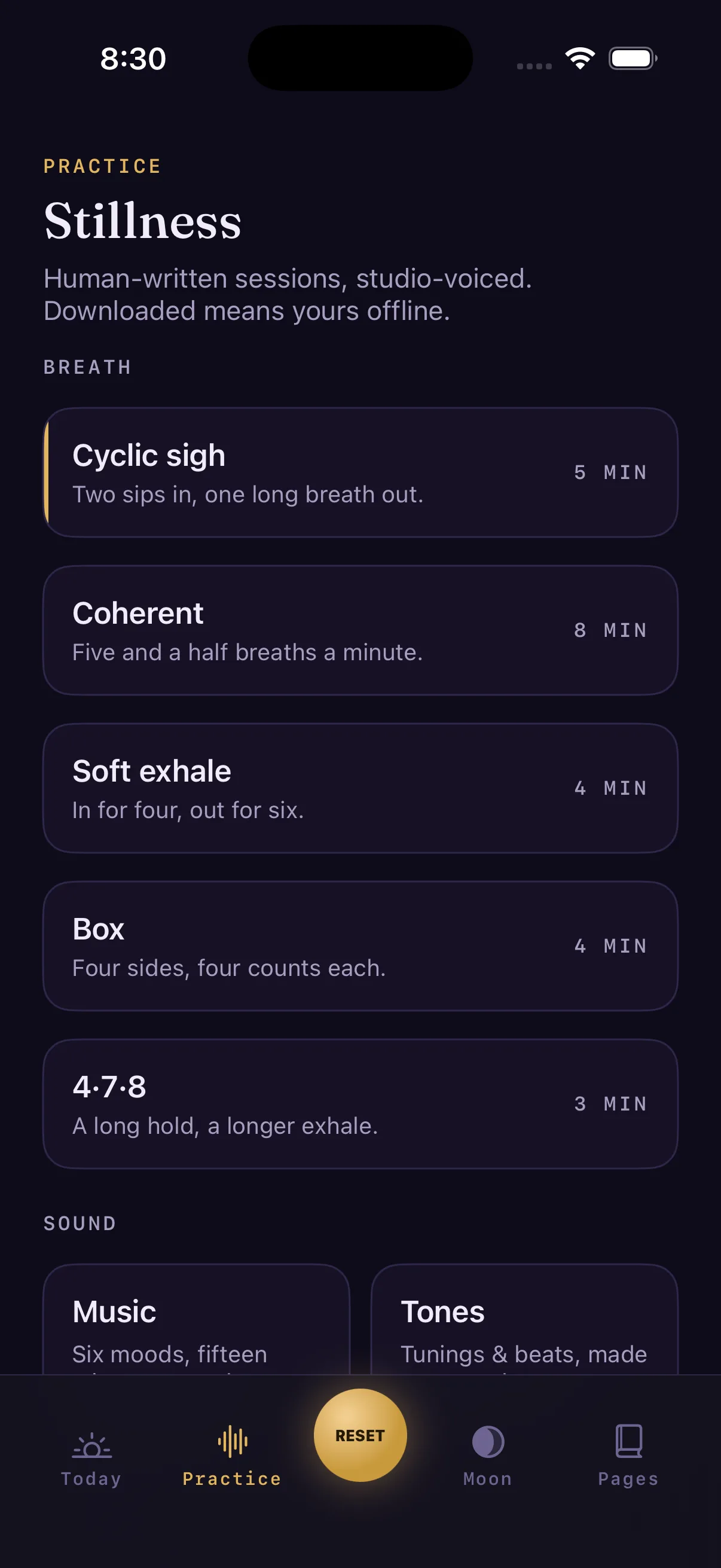
Five breath tools, each a published protocol rather than something invented for the app: the exhale-emphasized cyclic sigh at five minutes, coherent breathing at five and a half breaths a minute, soft exhale, box, and 4·7·8. The Reset sits on its own button in the middle of the tab bar, because the moment you need it is not the moment to go looking for it.
Underneath, a sound layer you can run on its own: tunings including 432 Hz and the Solfeggio pitches, a binaural beat, rain, and fifteen-minute music beds across six moods. Downloaded tracks play offline.
The deck
Reflection cards that do not predict anything
The evening ritual opens with a card from a forty-card deck drawn for this app. Before you pull one, the screen says what it is: a door, not a forecast.
Every card names an image and then asks you something. No card contains the words will, predicts, warns or fate, because none of them is doing that. The card supplies the door; you supply the meaning.
Draw The Lantern — what still lights the way — and what it actually asks you is this:
What are you carrying that still lights the way — and what have you been carrying out of habit?
Then there are two lines to write, and the night is counted. The deck reshuffles once you have worked through it.
After launch
Tarot, read as a mirror
A full 78-card tarot deck — 22 Major Arcana and 56 Minor across Wands, Cups, Swords and Pentacles — is the first thing being built after release. It is a second deck, kept separate from the nightly reflection card and drawn in the same night-lit style.
The framing does not change for it. A card carries a tradition of meanings, and a reading turns those meanings into questions: every card says what it is traditionally read as, and then asks you one thing. The words predict, will, warn and fate appear nowhere in the deck, and the line about cards being mirrors is printed on every reading.
The heavy cards — Death, The Tower, The Devil — carry an extra line of their own, saying plainly that in the tradition these are cards of endings and change, not a prediction of harm.
Spreads run from a single card to what was · what is · what I can choose, with dedicated New Moon and Full Moon layouts. Reversals stay off unless you turn them on. A card a day, the whole deck to browse and your own history of draws are free; multi-card spreads, reversals and attaching a reading to your journal come with Plena.
It is also entirely optional. One switch in Settings hides the deck, and tarot never enters the daily ritual either way — the evening card stays the reflection deck. Two apps' worth of practice, and you choose which one you're using.
The artwork is original. Traditional symbolism is followed closely enough that a reader who knows the cards will recognize them, but no historical deck's compositions are reproduced. Tarot in Voluna is offered for reflection and entertainment only: it does not predict events or outcomes, and it is not a substitute for professional medical, psychological, legal or financial advice.
Your material
No account, and everything you write stays yours
There is no sign-up, no profile and no server holding your practice. Your journal, check-ins and vows live on the iPhone. If you switch on iCloud sync they go to your own private iCloud and nowhere else; voice recordings are files and stay on the phone either way.
Every entry exports as Markdown, free, whether or not you ever pay for anything. And nothing you make will be locked behind a paywall later — if you record it while it is free, it stays available to you.
Lumen, a luna moth who grows through five stages as you practice, is the only thing keeping count. It never shrinks on the days you skip.
The standard
Every claim here is one you can look up
The wellness aisle runs on science you can't check — proprietary frequencies, neural rewiring, confident numbers with no paper behind them. Voluna takes the opposite line. Nothing in this app was invented to help sell it, and every technique in it has a name you can search before you download anything.
The Reset is the cyclic sigh — the exhale-emphasized pattern studied at Stanford. Coherent breathing runs at five and a half breaths a minute. The vow is built on if‑then planning, the method behind that 94-study meta-analysis. Voluna names the protocol and points at the work, because the result belongs to the practice you actually did.
The tones are described rather than sold. Voluna tells you what a tuning is traditionally paired with and leaves the meaning where it belongs — with you. The binaural beat is set out exactly as it behaves: clear on headphones, a soft pulse out loud. A good room to sit in, described precisely, is worth more than a treatment we would have had to invent.
The moon is astronomy. Real phase data, computed on your device, marking the fresh-start moments people have kept by it for as long as there have been calendars. It is not forecasting your week, and the app never suggests otherwise.
Every word in Voluna was written for it — the card prompts, the affirmations, the session scripts. And the crisis lines on every screen where they could matter are verified before each release. That part was never marketing.
Voluna is a wellness practice, not medical care. It does not diagnose, treat, cure or prevent any condition, and it is not a substitute for professional advice, diagnosis or treatment. Breathwork is not for everyone: skip breath-holding patterns if you are pregnant or have a heart or lung condition, epilepsy, or panic attacks, and never practice breathwork while driving or in water. Keep tone volume gentle, and speak to a clinician first if you have epilepsy or a hearing condition. Strong feelings sometimes surface during meditation; you can stop at any time. If you are struggling, please talk to a professional, and if you are in crisis, contact a crisis line immediately. Apple, iPhone, iCloud, Siri and App Store are trademarks of Apple Inc., registered in the U.S. and other countries. Verntro Labs, LLC is not affiliated with, endorsed by or sponsored by Apple Inc., Stanford University, or any research group whose published work is referenced here.
Pricing
Both rituals free forever. About twenty dollars a year for the rest.
The daily practice is the free tier — not a trial of it. Plena adds the library and lifts the limits, at roughly a quarter of what the large meditation apps charge.
Free
- Both daily rituals, every day
- All five breath tools, including the Reset
- Three affirmations in your own voice
- The moon calendar and nightly card pulls
- Your journal — and export, always
Plena $19.99/yr · $59.99 once
- Unlimited voice recordings
- The full session library and music beds
- Event collectibles and extra flights for Lumen
Also planned monthly at $3.99. The annual plan is intended to open with a one-week free trial, and the one-time purchase never renews. If a paid tier is out of reach, Voluna will offer a scholarship — a free year, no proof required. Pricing and trial terms are set when the app reaches the App Store and may change before release.
- Requires
- iOS 17 or later
- Devices
- iPhone
- Price
- Free · $19.99/yr or $59.99 once for Plena
- Account
- None — no sign-up, no profile
- Sync
- Your own iCloud, off by default
- Widgets
- Home Screen, small and medium
- Siri
- Reset, Sunrise, Moonrise and card pull
- Offline
- Downloaded sessions play without a connection
Come back on the fourteenth day.
Voluna is still in development. LeasePace and STRAXE are on the App Store now, if you want to see how we finish things.